Model-Adjacent Products: Building the AI Ecosystem of the Future
Sonic Intelligence
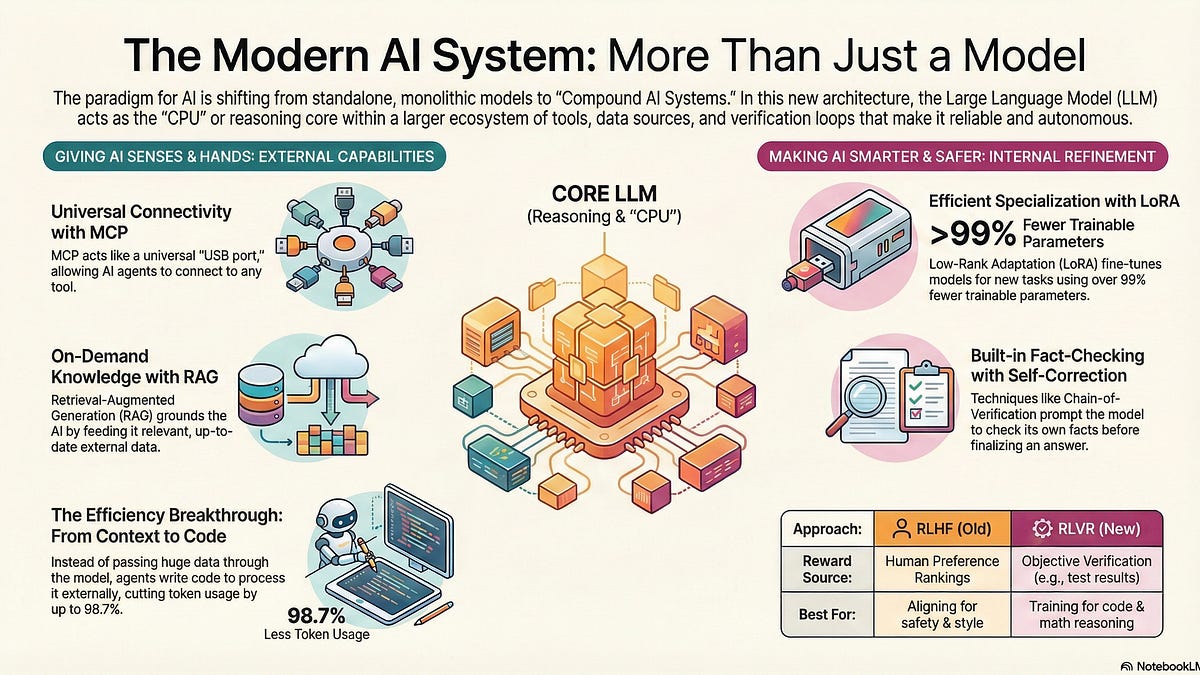
Model-Adjacent Products (MAPs) enhance LLMs by integrating external tools and data for continual learning and autonomy.
Explain Like I'm Five
"Imagine giving a super-smart robot extra tools and information so it can learn and do even more amazing things! Model-Adjacent Products are like those extra tools for AI."
Deep Intelligence Analysis
The development of MAPs requires a deep understanding of both human behavior and model capabilities. Engineers and product managers must work together to demystify these capabilities, understand the constraints, and adapt behavior for model autonomy. This includes understanding reward functions, token windows, hallucination controls, verifiers, context, and memory tooling. As we move from conversational interfaces to agentic workflows, these adjacent components become increasingly essential for handling complex, multi-step tasks in live real-world environments where reliability, cost efficiency, and data privacy are paramount.
The rise of MAPs has the potential to transform various industries by enabling more sophisticated and autonomous AI applications. However, it also presents new challenges, such as ensuring the reliability and safety of these complex systems. Addressing these challenges will require a collaborative effort between researchers, engineers, and policymakers to establish clear guidelines and best practices for the development and deployment of MAPs.
*Transparency Disclosure: This analysis was prepared by an AI language model to provide an objective overview of the topic. The AI model has been trained on a diverse range of data sources to ensure accuracy and avoid bias. The analysis is intended for informational purposes only and should not be considered as professional advice.*
Impact Assessment
MAPs are crucial for developing reliable, cost-efficient, and data-private AI systems. They enable LLMs to handle complex, multi-step tasks in real-world environments, moving beyond simple conversational interfaces.
Key Details
- Model-Adjacent Products (MAPs) extend LLMs with external tools and data.
- MAPs aim to overcome limitations of LLMs, such as fixed context windows.
- MAPs include API connectors and reinforcement learning frameworks.
- MAPs require understanding of model capabilities, reasoning, and flaws.
Optimistic Outlook
MAPs pave the way for more sophisticated and autonomous AI agents. By addressing the limitations of base models, MAPs can unlock new possibilities in various industries, leading to increased efficiency and innovation.
Pessimistic Outlook
Developing effective MAPs requires a deep understanding of model capabilities and limitations, which can be challenging. The complexity of these systems may also introduce new vulnerabilities and risks, requiring careful monitoring and mitigation strategies.
Get the next signal in your inbox.
One concise weekly briefing with direct source links, fast analysis, and no inbox clutter.
More reporting around this signal.
Related coverage selected to keep the thread going without dropping you into another card wall.