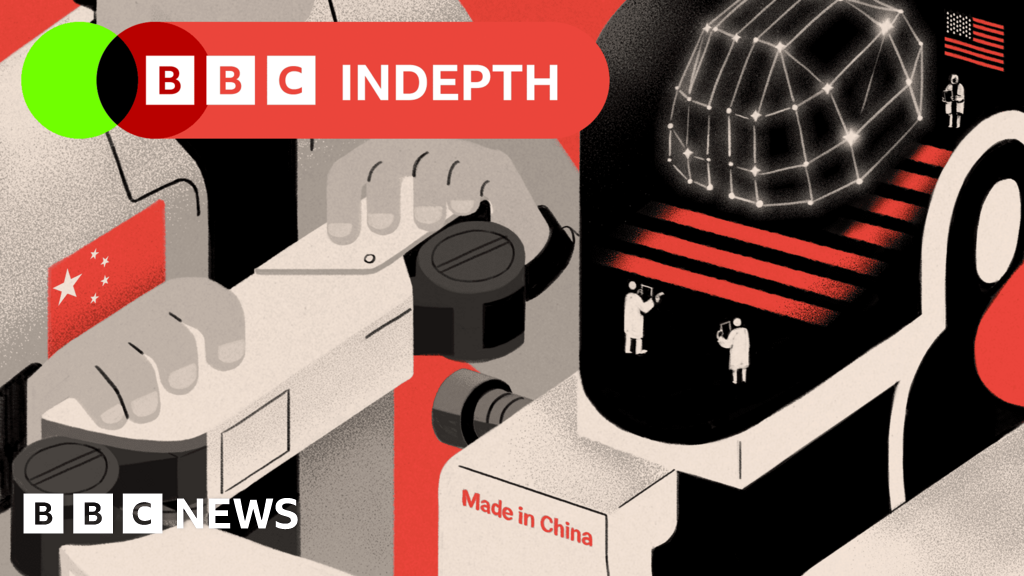
US Leads AI Brains, China Dominates AI Bodies in Global Tech Race
Sonic Intelligence
The Gist
The US leads in AI 'brains' (LLMs, chips), while China excels in AI 'bodies' (robotics).
Explain Like I'm Five
"Imagine two big countries are having a race to build the smartest robots. One country is really good at making the robots think (like their brains), and the other country is great at making the robots move and do things (like their bodies). They both want to be the best, and it's a very expensive race!"
Deep Intelligence Analysis
Conversely, China has established a clear lead in AI 'bodies,' particularly in robotics and humanoid systems. This specialization reflects different national innovation priorities and industrial strengths. While the US focuses on algorithmic advancements and computational power, China leverages its manufacturing prowess and industrial policy to dominate the physical manifestation of AI. This bifurcated development trajectory creates a complex geopolitical landscape where each nation possesses critical, yet distinct, technological leverage.
The long-term implications of this dual-track AI race are profound. It suggests a future where global technological supply chains could become increasingly fragmented, with nations seeking to secure their respective advantages. This competition could drive accelerated innovation in both cognitive and physical AI domains, but it also carries the risk of increased technological nationalism and reduced international collaboration. The strategic challenge for both the US and China will be to maintain their leads while simultaneously attempting to integrate or counter the other's strengths, potentially leading to a new era of strategic technological competition that reshapes global economic and military power balances.
Impact Assessment
This bifurcated leadership in AI development — US in cognitive AI and China in embodied AI — sets the stage for a complex geopolitical and economic competition. The control over foundational technologies like advanced microchips (US) and manufacturing capabilities for physical AI systems (China) will dictate future innovation trajectories and global power dynamics.
Read Full Story on BBC NewsKey Details
- ● The US holds an advantage in AI 'brains,' encompassing chatbots, microchips, and large language models.
- ● China demonstrates superiority in AI 'bodies,' specifically in robotics, including humanoid robots.
- ● OpenAI launched ChatGPT on November 30, 2022.
- ● OpenAI claims over 900 million people use ChatGPT weekly.
- ● Nvidia was valued at $5 trillion in October (source claims), becoming the world's most valuable company.
Optimistic Outlook
This competitive dynamic could spur rapid innovation in both cognitive and embodied AI, leading to breakthroughs that benefit humanity globally. Specialization might foster international collaboration in areas where one nation's strength complements the other's, accelerating the overall pace of AI development.
Pessimistic Outlook
The intense competition risks escalating into a technological arms race, potentially leading to increased protectionism, supply chain fragmentation, and reduced data sharing. This could hinder global AI progress, create dual-use technology proliferation concerns, and exacerbate geopolitical tensions.

The Signal, Not
the Noise|
Join AI leaders weekly.
Unsubscribe anytime. No spam, ever.
Generated Related Signals

Toronto Neighborhood Debates AI Surveillance for 'Virtual Gated Community'
Toronto's Rosedale neighborhood debates AI surveillance for a 'virtual gated community'.

Federal AI Rush Echoes Past Tech Traps: Beware the 'Free Lunch'
Federal AI adoption risks repeating past tech procurement pitfalls.

AI Agents: The Unresolved Liability Crisis Threatening Enterprise Adoption
Unclear liability for AI agents automating business decisions poses significant enterprise risk.
Vix AI Coding Agent Claims 50% Cost Reduction Over Claude Code
Vix AI coding agent demonstrates significant cost and time savings over Claude Code.

Arcee Launches Trinity LLM, Challenges Western Reliance on Chinese AI
Arcee's new Trinity LLM aims to provide a Western open-source alternative to Chinese models.

Anthropic's Claude Mythos Preview Autonomously Finds Thousands of High-Severity Vulnerabilities in Major OS and Browsers
Anthropic's new AI model, Claude Mythos Preview, autonomously identified thousands of high-severity vulnerabilities acro...