WordPress's Agentic Web Vision Faces Hidden User Token Cost Crisis
Sonic Intelligence
WordPress's AI agent vision risks failure due to unaddressed, escalating token costs for end-users.
Explain Like I'm Five
"Imagine you're talking to a smart robot that helps you make your website. Every time you ask it something, even if you just chat, it costs a tiny bit of money. The people who made the robot know how to ask it questions in a cheap way, but you might not, so your costs could get really big without you knowing!"
Deep Intelligence Analysis
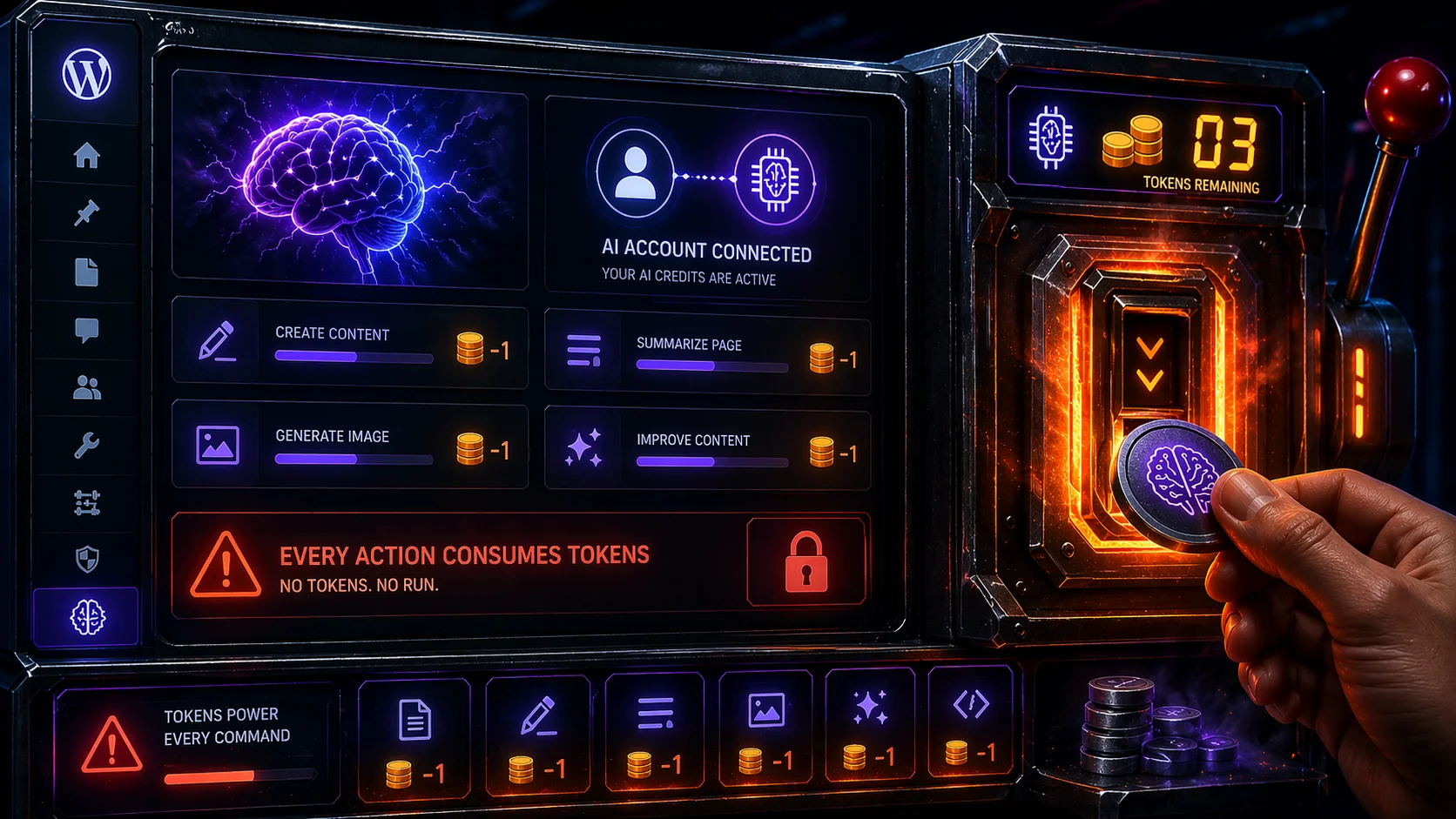
The core issue stems from the fundamental difference in AI interaction patterns between developers and typical end-users. While developers craft lean, optimized prompts to minimize token consumption—the unit of billing for AI models like Claude or Gemini—average users engage in natural, conversational exchanges. These iterative, less precise interactions, though intuitive for humans, translate directly into exponentially higher token usage and, consequently, greater financial cost. The Abilities API, while enabling powerful agentic functions, becomes a direct conduit for these accumulating costs, with plugins already integrating this infrastructure without a clear cost-mitigation strategy for the non-technical user base.
This cost disparity poses a significant threat to WordPress's long-term agentic web aspirations. If users face unexpected and escalating bills, the platform risks alienating its core demographic, who value accessibility and predictable costs. For the agentic web to truly flourish on WordPress, Automattic must prioritize transparent cost communication, implement intelligent token optimization features at the platform level, or explore alternative billing models that shield users from the complexities of token economics. Failure to do so could relegate this transformative vision to a niche feature, rather than the ubiquitous operating system it aspires to be, ultimately hindering the broader democratization of AI agent technology.
Visual Intelligence
flowchart LR
    A["End User"] --> B["Conversational Prompts"];
    B --> C["AI Agent Interaction"];
    C --> D["WordPress Abilities API"];
    D --> E["Token Consumption"];
    E --> F["High User Cost"];
    G["Developer"] --> H["Optimized Prompts"];
    H --> C;
    C --> D;
    D --> I["Low Token Consumption"];
    I --> J["Low Developer Cost"];
Auto-generated diagram · AI-interpreted flow
Impact Assessment
Automattic's strategic move to position WordPress as the 'operating system of the agentic web' is ambitious and technically feasible. However, the critical oversight of transparently communicating and managing AI token costs for end-users threatens to undermine adoption, potentially alienating the very community WordPress relies upon for its ecosystem's vitality.
Key Details
- WordPress MCP write capabilities are shipping in March 2026.
- The WordPress MCP Adapter connects the Abilities API to any MCP-aware AI client.
- Plugins like QATPT already integrate the Abilities API.
- Every AI agent interaction consumes tokens, billed by models like Claude, ChatGPT, and Gemini.
- End-users' conversational prompts incur significantly higher token costs than developers' optimized prompts.
Optimistic Outlook
If Automattic addresses the token cost transparency and optimization challenge proactively, WordPress could indeed become a dominant platform for the agentic web. By implementing smart cost-management features, educating users, or offering tiered pricing, WordPress could democratize AI agent creation, empowering millions of non-technical users to leverage advanced AI capabilities for content generation and site management.
Pessimistic Outlook
Failure to address the hidden token costs will likely lead to user frustration, unexpected bills, and a significant barrier to mainstream adoption of WordPress's AI features. This could erode trust, slow the growth of the agentic web ecosystem on WordPress, and ultimately cede market share to platforms that offer more predictable or transparent AI consumption models, jeopardizing Automattic's strategic vision.
Get the next signal in your inbox.
One concise weekly briefing with direct source links, fast analysis, and no inbox clutter.
More reporting around this signal.
Related coverage selected to keep the thread going without dropping you into another card wall.