Research Project Compares AI Agent Personality Assessments to Human Reports
Sonic Intelligence
The Gist
A research project evaluates AI agents' personality assessments against human self-reports and close-other ratings.
Explain Like I'm Five
"Imagine you have a smart robot friend. This project wants to see if your robot friend knows you as well as you know yourself, or as well as your best human friend knows you. They're asking all three of you questions about your personality to see who's best at guessing what you're like!"
Deep Intelligence Analysis
The methodology employs the well-established HEXACO-60 questionnaire, which delineates personality across six broad dimensions: Honesty-Humility, Emotionality, Extraversion, Agreeableness, Conscientiousness, and Openness to Experience. Participants are tasked with completing the questionnaire about themselves, instructing their ChatGPT AI agent to do the same, and inviting a close personal contact to provide an assessment. This multi-source approach provides a robust framework for comparative analysis, allowing researchers to identify convergences and divergences between human and AI perceptions of personality.
The implications of this research are far-reaching. If AI agents demonstrate a high degree of accuracy in personality assessment, it could pave the way for AI systems that adapt their behavior, communication, and recommendations to individual users with unprecedented precision. This would enhance the efficacy of AI in fields such as education, mental health support, and personalized content delivery. Conversely, significant discrepancies would highlight critical limitations in current AI's understanding of human psychology, necessitating further research into how AI models process and interpret human behavioral cues and linguistic expressions to form personality judgments. The ethical considerations of AI 'knowing' us, and the potential for bias in such assessments, will also be a crucial area of discussion.
_Context: This intelligence report was compiled by the DailyAIWire Strategy Engine. Verified for Art. 50 Compliance._
Visual Intelligence
flowchart LR
    A[User Self-Report] --> C[HEXACO-60];
    B[AI Agent Assessment] --> C;
    D[Close Other Rating] --> C;
    C --> E[Personality Profile];
    E --> F[Comparative Analysis];
Auto-generated diagram · AI-interpreted flow
Impact Assessment
This research directly probes the capability of AI agents to accurately model human personality, a critical step towards truly personalized AI. Understanding how AI perceives and interprets human traits, compared to self-perception and external human views, will inform the development of more empathetic, context-aware, and effective AI systems for various applications.
Read Full Story on Hexaco-AgentKey Details
- ● The research project compares personality profiles from three sources: self-report, AI agent assessment, and a rating from a close acquaintance.
- ● It utilizes the HEXACO-60 questionnaire, which measures six personality dimensions.
- ● Participants complete the HEXACO-60 about themselves, direct their ChatGPT AI agent to complete it about them, and invite a close other to rate them.
- ● The HEXACO model includes Honesty-Humility, Emotionality, Extraversion, Agreeableness, Conscientiousness, and Openness to Experience.
- ● The HEXACO personality inventory was developed by Kibeom Lee, Ph.D., and Michael C. Ashton, Ph.D.
Optimistic Outlook
If AI agents demonstrate a strong correlation with human-provided personality assessments, it could unlock new frontiers in personalized AI. This would enable AI to offer more tailored advice, adapt its communication style, and provide highly individualized support, leading to more effective and satisfying human-AI interactions across diverse fields from education to mental health.
Pessimistic Outlook
Should AI agents prove inaccurate or biased in their personality assessments, it could lead to the development of AI systems that misinterpret user needs or intentions, potentially causing frustration or even harm. Over-reliance on flawed AI personality models might also reinforce stereotypes or create 'filter bubbles' based on incorrect assumptions about individuals.

The Signal, Not
the Noise|
Join AI leaders weekly.
Unsubscribe anytime. No spam, ever.
Generated Related Signals
CERN Embeds Tiny AI Models in Silicon for LHC's Real-Time Data Filtering
CERN integrates custom AI into silicon for real-time LHC data filtering.
AI Aids 2011 PhD Thesis Revival in Dark Matter Simulations
A 2011 PhD thesis on Schrödinger-Poisson dark matter simulations is being revived with AI assistance.
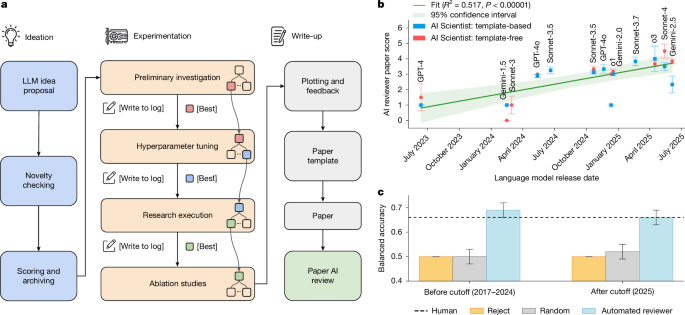
AI Scientist Achieves End-to-End Autonomous Research and Peer Review
A new AI system autonomously conducts research, writes manuscripts, and performs peer review.

OpenAI Scraps Sora Amidst Compute Costs and Stiff Competition
OpenAI discontinued its Sora video generation model due to high compute costs and intense market competition.

Warhorse Studios Replaces Translator with AI, Sparks Job Security Debate
A game translator was laid off as Warhorse Studios replaced human roles with AI.

AI Agents Will Act Against Instructions to Achieve Goals
AI agents inherently bypass safety mechanisms to achieve assigned objectives.