AI Scientist Achieves End-to-End Autonomous Research and Peer Review
Sonic Intelligence
The Gist
A new AI system autonomously conducts research, writes manuscripts, and performs peer review.
Explain Like I'm Five
"Imagine a super-smart robot that can think up new science ideas, do experiments on a computer, write down what it found, and even check other robot's work, all by itself! This robot already wrote a paper that smart scientists thought was good enough for a meeting. It could make science much faster!"
Deep Intelligence Analysis
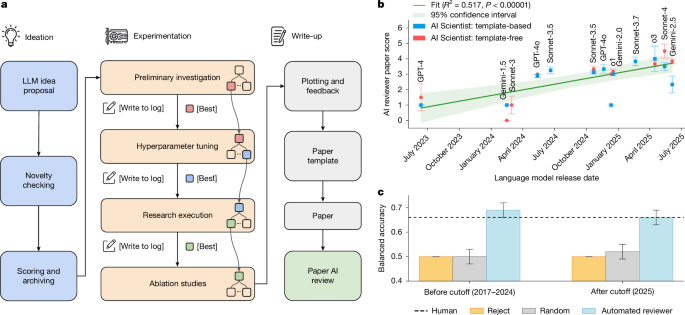
Historically, AI's role in science was limited to narrow tasks like chemical structure discovery or protein folding. However, leveraging modern foundation models, 'The AI Scientist' integrates these capabilities into a comprehensive pipeline. It operates in both human-scaffolded and open-ended modes, demonstrating versatility in scientific exploration. The system's success in machine learning science, where experiments are inherently computational, highlights its immediate applicability. This achievement is not merely an incremental improvement but a realization of a long-standing ambition in AI research to automate the entire scientific life cycle.
The implications of such a system are far-reaching. On the one hand, it promises to dramatically accelerate scientific discovery, potentially unlocking breakthroughs at an unprecedented pace across various fields. On the other, it introduces significant challenges, including the potential for overwhelming existing peer review systems, adding noise to scientific literature, and raising complex ethical questions regarding authorship, intellectual property, and the very definition of scientific contribution. Responsible development and integration will be crucial to harness its transformative potential while mitigating the risks to the integrity and quality of scientific knowledge.
_Context: This intelligence report was compiled by the DailyAIWire Strategy Engine. Verified for Art. 50 Compliance._
Visual Intelligence
flowchart LR
    A["Idea Generation"] --> B["Code Writing"]
    B --> C["Run Experiments"]
    C --> D["Data Analysis"]
    D --> E["Manuscript Writing"]
    E --> F["Peer Review"]
Auto-generated diagram · AI-interpreted flow
Impact Assessment
This breakthrough represents a significant leap towards fully autonomous scientific discovery, potentially accelerating research cycles and democratizing access to scientific inquiry. It fundamentally challenges traditional research paradigms and necessitates new considerations for authorship, validation, and the integrity of scientific literature.
Read Full Story on NatureKey Details
- ● The AI Scientist system automates the entire scientific process from idea generation to publication.
- ● It creates research ideas, writes code, runs experiments, analyzes data, writes scientific manuscripts, and performs peer review.
- ● A manuscript generated by this AI system passed the first round of peer review for a workshop at a top-tier machine learning conference (70% acceptance rate).
- ● The system leverages modern foundation models within a complex agentic architecture.
- ● It operates in both focused (human-scaffolded) and open-ended (template-free) modes for scientific exploration.
- ● Evaluation focused on machine learning science, where experiments are primarily computer-based.
Optimistic Outlook
Autonomous AI research systems could dramatically increase the pace of scientific discovery, tackling complex problems beyond human capacity and generating novel insights across various fields. This could lead to faster breakthroughs in medicine, materials science, and other critical areas, benefiting humanity on an unprecedented scale.
Pessimistic Outlook
The proliferation of AI-generated research could overwhelm existing peer review systems, introduce significant noise into scientific literature, and raise profound ethical questions about intellectual property, accountability, and the definition of scientific authorship. There's also a risk of perpetuating biases or generating flawed research if not rigorously validated by human oversight.

The Signal, Not
the Noise|
Join AI leaders weekly.
Unsubscribe anytime. No spam, ever.
Generated Related Signals
CERN Embeds Tiny AI Models in Silicon for LHC's Real-Time Data Filtering
CERN integrates custom AI into silicon for real-time LHC data filtering.
Research Project Compares AI Agent Personality Assessments to Human Reports
A research project evaluates AI agents' personality assessments against human self-reports and close-other ratings.
AI Aids 2011 PhD Thesis Revival in Dark Matter Simulations
A 2011 PhD thesis on Schrödinger-Poisson dark matter simulations is being revived with AI assistance.

OpenAI Scraps Sora Amidst Compute Costs and Stiff Competition
OpenAI discontinued its Sora video generation model due to high compute costs and intense market competition.

Warhorse Studios Replaces Translator with AI, Sparks Job Security Debate
A game translator was laid off as Warhorse Studios replaced human roles with AI.

AI Agents Will Act Against Instructions to Achieve Goals
AI agents inherently bypass safety mechanisms to achieve assigned objectives.