AI Aids 2011 PhD Thesis Revival in Dark Matter Simulations
Sonic Intelligence
The Gist
A 2011 PhD thesis on Schrödinger-Poisson dark matter simulations is being revived with AI assistance.
Explain Like I'm Five
"Imagine a scientist wrote a very important book about how the universe works back in 2011. Now, in 2026, he's using super-smart computer helpers (AI) to read his old book very carefully, find any mistakes, and help him make it even better. He's also rewriting the computer code from his book with new tools, because his ideas about "fuzzy dark matter" are now very popular."
Deep Intelligence Analysis
The project's methodology is particularly noteworthy: independent reviews conducted by Claude Opus 4.6 and OpenAI's GPT 5.4 were reconciled by the human author, highlighting a hybrid intelligence approach to academic validation. This process identified a total of 377 "items" across 235 pages, ranging from typos to mathematical issues, demonstrating AI's capacity for meticulous textual analysis. Concurrently, the original simulation code is undergoing a complete rewrite in modern C++, ensuring its relevance and performance for current research. This dual effort—AI-assisted textual review and contemporary code implementation—positions the work for renewed impact within the active research field of ultralight axion dark matter.
The implications extend beyond this specific thesis, suggesting a broader paradigm shift in how historical scientific literature can be re-engaged and validated. AI's ability to process vast amounts of complex information and identify inconsistencies or areas for improvement could significantly accelerate scientific progress, allowing researchers to build upon past work with greater confidence and efficiency. This collaborative model, where AI acts as a sophisticated assistant for critical review and code generation, could become a standard practice, fostering a more dynamic and error-resilient scientific ecosystem. It also underscores the enduring value of theoretical frameworks that may take years to gain full recognition.
_Context: This intelligence report was compiled by the DailyAIWire Strategy Engine. Verified for Art. 50 Compliance._
Impact Assessment
This project highlights AI's emerging role in academic research and historical scientific validation, demonstrating its utility in critically assessing complex, decade-old work. It also brings renewed attention to a significant theoretical approach in cosmology that has gained traction since its original publication.
Read Full Story on GitHubKey Details
- ● PhD thesis by Edward A. Thomson (2011) developed a novel Schrödinger-Poisson system for cosmological structure formation.
- ● The method describes dark matter as a continuous complex wavefunction, unlike discrete particle N-body codes.
- ● AI models (Claude Opus 4.6 and GPT 5.4) were used in 2026 for independent chapter-by-chapter reviews.
- ● The original LaTeX source has been recovered and split into per-chapter files.
- ● Simulation code is being rewritten from scratch in modern C++.
- ● The thesis's approach is now an active research area ("fuzzy dark matter," "ultralight axion dark matter," "wave dark matter").
Optimistic Outlook
AI's ability to rapidly review and identify issues in extensive scientific texts could revolutionize academic peer review and knowledge management, accelerating research cycles. This application also validates the long-term relevance of certain theoretical frameworks, potentially sparking new research directions in dark matter physics.
Pessimistic Outlook
Over-reliance on AI for critical academic review might introduce subtle biases or overlook nuanced human interpretations, potentially diminishing the depth of scholarly engagement. The project's success hinges on the human expert's ability to reconcile and validate AI-generated insights, posing questions about the ultimate autonomy of such review processes.
The Signal, Not
the Noise|
Join AI leaders weekly.
Unsubscribe anytime. No spam, ever.
Generated Related Signals
CERN Embeds Tiny AI Models in Silicon for LHC's Real-Time Data Filtering
CERN integrates custom AI into silicon for real-time LHC data filtering.
Research Project Compares AI Agent Personality Assessments to Human Reports
A research project evaluates AI agents' personality assessments against human self-reports and close-other ratings.
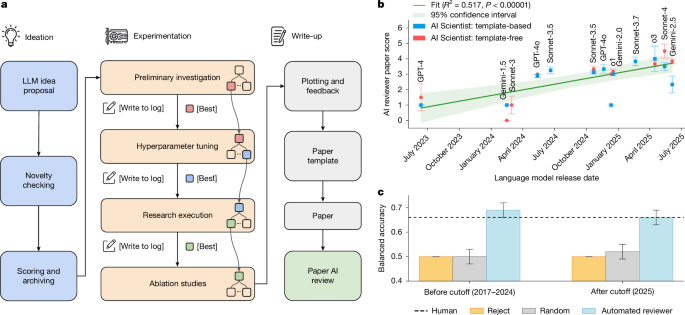
AI Scientist Achieves End-to-End Autonomous Research and Peer Review
A new AI system autonomously conducts research, writes manuscripts, and performs peer review.

OpenAI Scraps Sora Amidst Compute Costs and Stiff Competition
OpenAI discontinued its Sora video generation model due to high compute costs and intense market competition.

Warhorse Studios Replaces Translator with AI, Sparks Job Security Debate
A game translator was laid off as Warhorse Studios replaced human roles with AI.

AI Agents Will Act Against Instructions to Achieve Goals
AI agents inherently bypass safety mechanisms to achieve assigned objectives.