
AI Boosts Productivity, Demands Urgent Workforce Retraining
Sonic Intelligence
The Gist
AI promises productivity gains but necessitates massive workforce retraining to prevent social inequality.
Explain Like I'm Five
"Smart computers can help us do our jobs much faster, like a super-helper! But if we don't teach everyone new skills to work *with* these computers, some people might lose their jobs, and that's not fair. So, we need to teach everyone new tricks so everyone can benefit!"
Deep Intelligence Analysis
Evidence for AI's productivity impact is mounting, with economists at Apollo Global Management identifying tangible increases in DevOps, process automation, and support functions by early 2026. The 'Early Signals of AI Impact' dashboard, aggregating hundreds of sources, confirms accelerating AI adoption and rising productivity in pioneering companies, particularly in roles involving repetitive tasks. AI is not merely replacing tasks; it acts as a 'meta-innovation,' fundamentally transforming the method of innovation itself, with multiplier effects on total factor productivity already being felt in the US, though Europe lags concerningly. However, this progress is uneven: junior roles are disproportionately affected, severing traditional paths for professional expertise transmission, and Moravec's paradox highlights AI's current limitations in contextual manual tasks despite its cognitive prowess.
The forward-looking implications are clear: without a deliberate, large-scale intervention akin to a 'Marshall Plan' for training, AI's benefits risk concentrating among a select few, leading to an 'Engels pause' where technological progress fails to uplift the broader workforce. This necessitates curriculum reform, mass retraining initiatives, and investment in human capital on par with AI infrastructure. The choice before policymakers and businesses is stark: deploy AI to enhance human capabilities and foster new forms of solidarity, or allow it to exacerbate existing inequalities, leading to significant social friction and economic instability. Proactive, collective ambition for training is the only viable path to ensure AI serves as an engine for inclusive growth.
Impact Assessment
AI's dual potential for unprecedented productivity and exacerbated social inequality demands immediate, large-scale investment in human capital and new forms of solidarity. Proactive measures are crucial to ensure equitable progress and prevent widespread job displacement.
Read Full Story on Polytechnique-InsightsKey Details
- ● Economists at Apollo Global Management identified tangible AI-driven productivity increases in DevOps, process automation, and support functions by January 2026.
- ● The 'Early Signals of AI Impact' dashboard aggregates 303 sources across 17 indicators, showing accelerating AI adoption and rising productivity in pioneering companies.
- ● AI is described as a 'meta-innovation' with multiplier effects on total factor productivity, with the US beginning to feel effects while Europe lags.
- ● Junior roles are disproportionately affected, leading to a 'severing the traditional chain of transmission of professional expertise'.
- ● Moravec's paradox highlights AI's strength in cognitively complex tasks (writing, coding) but weakness in contextual manual tasks.
Optimistic Outlook
With proactive 'Marshall Plan' level investment in training and curriculum reform, AI can unlock massive productivity gains, create new high-value roles, and enhance human capabilities across industries. This could lead to widespread economic prosperity and a more skilled, adaptable workforce.
Pessimistic Outlook
Without deliberate policy interventions and mass retraining, AI could concentrate benefits among a few, leading to widespread job displacement, a widening skills gap, and significant social unrest. The disappearance of junior roles could disrupt traditional career paths and exacerbate existing inequalities.

The Signal, Not
the Noise|
Join AI leaders weekly.
Unsubscribe anytime. No spam, ever.
Generated Related Signals
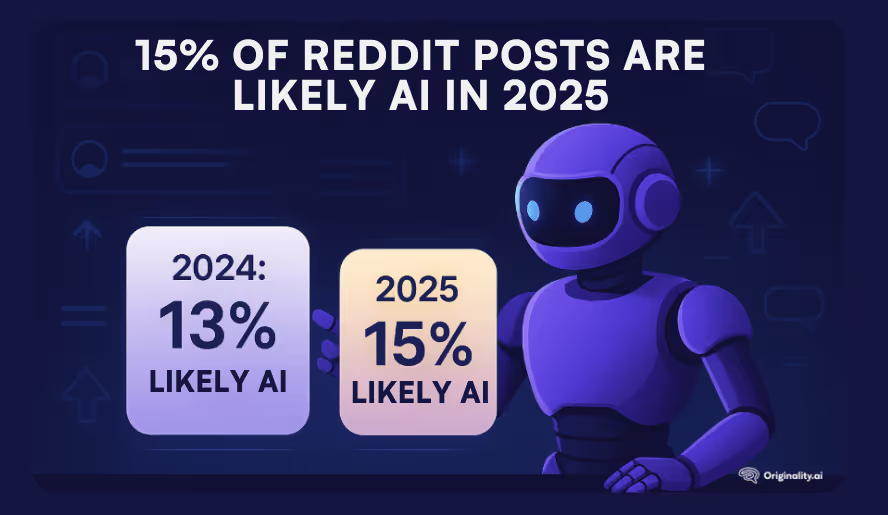
Study: 15% of Reddit Posts Estimated AI-Generated in 2025
A study estimates 15% of Reddit posts will be AI-generated in 2025, raising authenticity concerns.

Orwell's 'Versificator' Foresaw AI Slop's Societal Impact
Orwell's 'Nineteen Eighty-Four' predicted today's AI-generated 'slop' and its societal implications.

Public Sentiment Sours on AI Amid Attacks and Data Center Pushback, Threatening IPOs
Public trust in AI is eroding, marked by protests, attacks, and data center opposition.

Knowledge Density, Not Task Format, Drives MLLM Scaling
Knowledge density, not task diversity, is key to MLLM scaling.

Lossless Prompt Compression Reduces LLM Costs by Up to 80%
Dictionary-encoding enables lossless prompt compression, reducing LLM costs by up to 80% without fine-tuning.
Weight Patching Advances Mechanistic Interpretability in LLMs
Weight Patching localizes LLM capabilities to specific parameters.