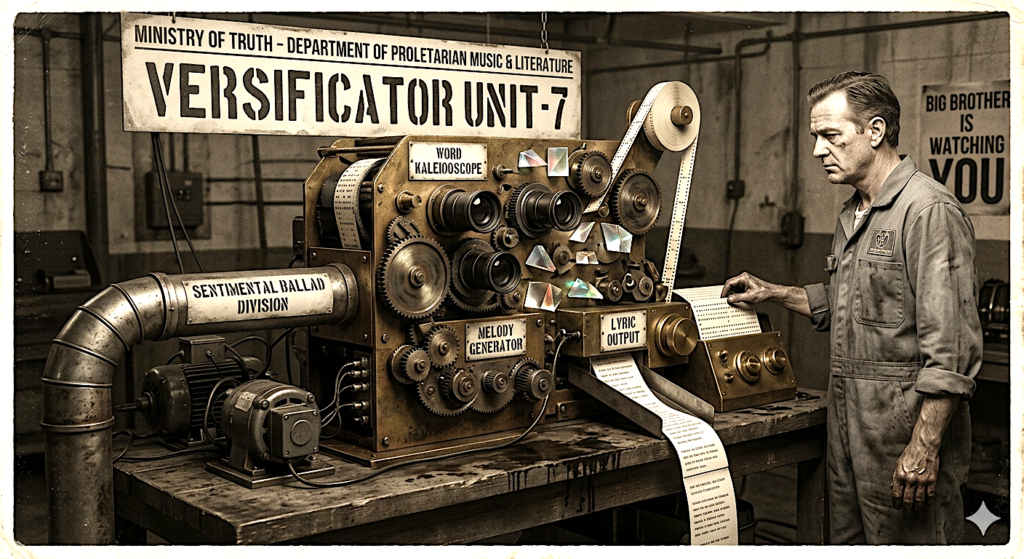
Orwell's 'Versificator' Foresaw AI Slop's Societal Impact
Sonic Intelligence
The Gist
Orwell's 'Nineteen Eighty-Four' predicted today's AI-generated 'slop' and its societal implications.
Explain Like I'm Five
"Imagine a machine that makes up silly stories and songs all by itself, and everyone just listens to them because they're easy. A long time ago, a writer named George Orwell imagined something like that in his book. Now, with computers making lots of stories and pictures, it's a bit like his idea came true. It makes us wonder if we're getting too much easy, not-so-great stuff from computers."
Deep Intelligence Analysis
This historical parallel gains significance when considering the rapid advancements in large language models and other generative AI. While Isaac Asimov, writing in 1980 during an 'AI winter,' dismissed 'Nineteen Eighty-Four' as a poor technological prophecy, the developments of the 2020s have validated Orwell's foresight in an unexpected domain. The core technical capability — automated content generation — is now a reality, with systems capable of producing convincing narratives and media forms. The societal context, where such low-effort content gains genuine popularity, underscores a potential shift in public demand for undemanding media, echoing the Ministry of Truth's strategy.
The implications are profound for both content creators and consumers. The ease of generating vast quantities of 'AI slop' threatens to devalue human creativity and critical discernment, potentially flooding the digital landscape with mediocre, algorithmically optimized content. This scenario necessitates a heightened emphasis on media literacy and the cultivation of individual critical thinking to navigate an increasingly automated information environment. The challenge lies in leveraging AI's generative power responsibly, ensuring it augments rather than diminishes the quality and depth of human experience.
Transparency Footer: This analysis was generated by an AI model based on the provided source material.
Impact Assessment
This analysis draws a compelling parallel between dystopian fiction and current AI capabilities, raising concerns about the quality and societal impact of mass-produced, low-effort content. It highlights how technology can fulfill predictions made decades ago, albeit in unexpected ways, prompting critical reflection on content consumption.
Read Full Story on OpencultureKey Details
- ● Orwell's 'versificator' in 1984 produced 'rubbishy newspapers' and 'sentimental songs' by mechanical means.
- ● The content was created 'without any human intervention whatever'.
- ● Isaac Asimov critiqued 1984 as a poor prophecy in 1980, during an 'AI winter'.
- ● Modern AI can produce convincing stories, songs, essays, poems, novels, and films.
Optimistic Outlook
This comparison can serve as a critical lens, prompting developers and users to prioritize quality and ethical considerations in AI content generation. It encourages discernment, potentially fostering a demand for more sophisticated and human-curated AI applications and a more critical public.
Pessimistic Outlook
The proliferation of 'AI slop' risks devaluing human creativity and critical thinking, potentially leading to a deluge of undemanding, pacifying media that mirrors Orwell's dystopia. This could erode public discernment and make it harder to distinguish high-quality, human-created content from machine output.

The Signal, Not
the Noise|
Join AI leaders weekly.
Unsubscribe anytime. No spam, ever.
Generated Related Signals

AI Boosts Productivity, Demands Urgent Workforce Retraining
AI promises productivity gains but necessitates massive workforce retraining to prevent social inequality.
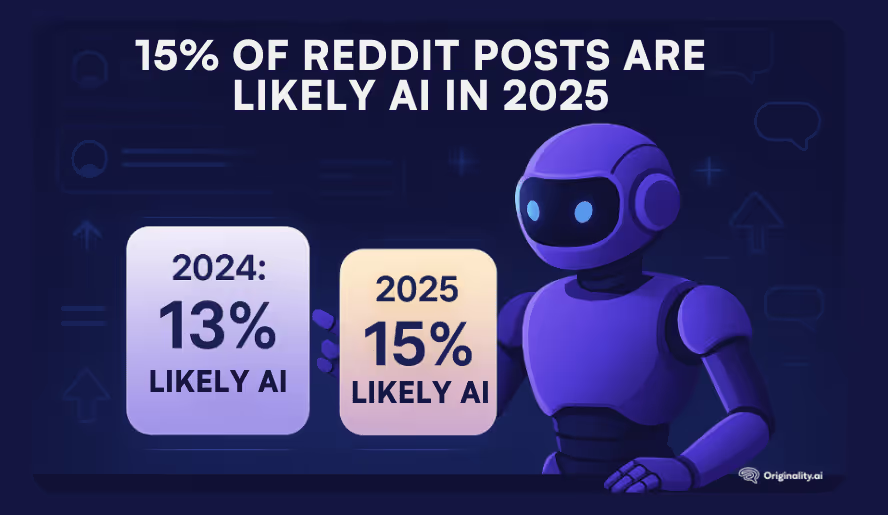
Study: 15% of Reddit Posts Estimated AI-Generated in 2025
A study estimates 15% of Reddit posts will be AI-generated in 2025, raising authenticity concerns.

Public Sentiment Sours on AI Amid Attacks and Data Center Pushback, Threatening IPOs
Public trust in AI is eroding, marked by protests, attacks, and data center opposition.
LocalMind Unleashes Private, Persistent LLM Agents with Learnable Skills on Your Machine
A new CLI tool enables powerful, private LLM agents with memory and skills on local machines.

Knowledge Density, Not Task Format, Drives MLLM Scaling
Knowledge density, not task diversity, is key to MLLM scaling.

New Dataset Enables AI Agents to Anticipate Human Intervention
New research dataset enables AI agents to anticipate human intervention.