
Economists Urge 'Manhattan Project' for AI Job Impact Data
Sonic Intelligence
The Gist
Current AI job impact predictions are flawed, necessitating new data collection.
Explain Like I'm Five
"Imagine you want to know if a robot will take your parent's job. Right now, we just look at how many small tasks a robot *could* do in that job. But that's like saying a robot can make a sandwich, so it can run a whole restaurant! An expert says we need much better information to really know what's going to happen, so we can plan properly."
Deep Intelligence Analysis
Existing tools, such as the US government's 1998 task catalogue, have been leveraged by entities like OpenAI and Anthropic to quantify AI exposure and usage. OpenAI's December analysis, for instance, indicated a real estate agent's job was 28% exposed to AI, while Anthropic used similar data in February to map Claude's conversational tasks. However, economist Alex Imas from the University of Chicago critically argues that 'exposure alone is a completely meaningless tool for predicting displacement.' He highlights that the cost-effectiveness and comprehensive capability of AI to perform *all* tasks within a role, without human direction, are not guaranteed, rendering simple exposure metrics insufficient for forecasting job loss in the vast majority of professions.
The call for a 'Manhattan Project' level of investment in new data collection methodologies signifies a critical pivot point. Without granular, real-world data that tracks actual AI integration, cost-benefit analyses, and the emergence of new human-AI hybrid roles, policymakers and businesses will continue to operate in the dark. This proactive data initiative is essential not only to accurately predict workforce transformations but also to design effective retraining programs, foster economic resilience, and prevent a reactive, crisis-driven approach to technological unemployment. The future of work hinges on moving beyond theoretical exposure to empirical understanding.
_Context: This intelligence report was compiled by the DailyAIWire Strategy Engine. Verified for Art. 50 Compliance._
Impact Assessment
Accurate data on AI's workforce impact is crucial to mitigate widespread panic and enable effective policy formulation. Without precise metrics beyond mere 'exposure,' societies risk mismanaging the transition, potentially exacerbating economic instability and social unrest.
Read Full Story on MIT Technology ReviewKey Details
- ● The US government's task catalogue, launched in 1998, chronicles thousands of individual job tasks.
- ● OpenAI utilized this 1998 data in December to estimate job 'exposure' to AI, finding a real estate agent 28% exposed.
- ● Anthropic subsequently used this data in February to analyze Claude conversations and identify AI-completed tasks.
- ● Anthropic CEO Dario Amodei has stated AI could act as a 'general labor substitute' for all jobs within five years.
- ● Economist Alex Imas from the University of Chicago asserts that 'exposure alone is a completely meaningless tool for predicting displacement.'
Optimistic Outlook
A concerted effort to collect granular, real-world data on AI's job displacement and augmentation could lead to proactive policy development. This would enable targeted retraining programs and foster a more adaptive workforce, transforming potential threats into opportunities for economic restructuring and growth.
Pessimistic Outlook
Failure to develop superior data collection methods will perpetuate an environment of fear and speculation regarding AI's impact. This could lead to ill-informed policy decisions, hinder economic planning, and potentially exacerbate social inequalities as job markets undergo unpredictable shifts without adequate preparation.

The Signal, Not
the Noise|
Join AI leaders weekly.
Unsubscribe anytime. No spam, ever.
Generated Related Signals

OpenAI Advocates Four-Day Work Week for AI Era Adaptation
OpenAI proposes a four-day work week to adapt to AI-driven labor shifts.
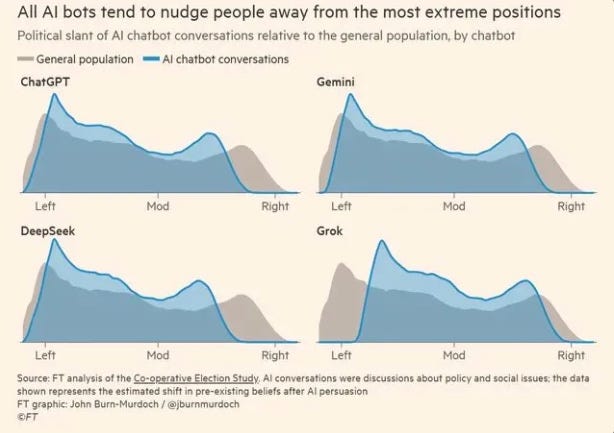
AI's Political Leanings: Study Debunked on Moderating Extremes
A widely shared study claiming AI moderates political extremes faces significant methodological scrutiny.

AI's Homogenizing Effect: Eroding Original Thought in Higher Education
AI chatbots are homogenizing student expression and critical thinking in university settings.

Toronto Neighborhood Debates AI Surveillance for 'Virtual Gated Community'
Toronto's Rosedale neighborhood debates AI surveillance for a 'virtual gated community'.

Google's AI Overviews Exhibits 10% Error Rate, Generating Millions of Daily Misinformation Instances
Google's AI Overviews shows 10% inaccuracy, creating millions of daily errors.

Uber Expands AWS AI Chip Adoption, Signaling Cloud Infrastructure Shift
Uber expands AWS cloud contract, adopting Graviton and trialing Trainium3 AI chips.