Geopolitical Chokehold: Hormuz Blockage Threatens Billions in AI Funding
Sonic Intelligence
The Gist
Hormuz Strait blockage jeopardizes billions in Gulf sovereign wealth fund AI investments.
Explain Like I'm Five
"Imagine a big piggy bank that rich countries in the desert fill with money they get from selling oil. They use this money to invest in super smart computer ideas (AI). But now, the main "road" for their oil ships is blocked. Less oil means less money in their piggy bank, which means less money for new AI ideas. This makes the *really* big computer companies even more powerful because they have lots of their own money."
Deep Intelligence Analysis
The scale of Gulf SWF involvement in AI has been immense, accelerating nearly 700% from $9.4 billion in 2023 to an estimated $66 billion in 2025. Specific examples underscore this dependency: Saudi Arabia is the single largest investor in Softbank’s Vision Fund, a pivotal player in AI and tech investments, while Abu Dhabi’s commitment to OpenAI’s Stargate initiative rivals Oracle’s and has even surpassed Microsoft’s investment over the past two years. This deep financial integration means that any sustained disruption to oil revenues directly impacts the capital allocation strategies of these SWFs. Their primary mandate is to secure the welfare of their citizens, meaning excess profits, typically channeled into global investments, will now be diverted to domestic needs, leaving less for high-growth, high-risk ventures like AI startups.
The forward-looking implications are profound. A contraction in Gulf capital will inevitably strengthen the position of established Big Tech companies, which possess internal funding mechanisms and massive balance sheets, allowing them to weather market shifts more effectively. This could lead to a further consolidation of power and innovation within a few dominant players, potentially stifling the diversity and dynamism of the broader AI startup ecosystem. Furthermore, the reduced availability of mega-round funding could delay critical breakthroughs, slow market entry for new competitors, and ultimately reshape the global distribution of AI innovation, making it more concentrated and less accessible to independent ventures.
_Context: This intelligence report was compiled by the DailyAIWire Strategy Engine. Verified for Art. 50 Compliance._
Impact Assessment
The disruption of the Strait of Hormuz directly impacts the revenue streams of Gulf nations, threatening a significant portion of global AI investment capital. This could lead to a consolidation of power among existing Big Tech players and a substantial reduction in funding for AI startups and mega-rounds in late 2026 and 2027.
Read Full Story on HighabsolutevalueKey Details
- ● Gulf sovereign wealth funds (SWFs) contributed 18% of all AI funding outside Big Tech in 2025.
- ● These funds represented 31% of all AI-related capital in 2025.
- ● AI funding from Gulf SWFs surged nearly 700% from $9.4B in 2023 to $66B in 2025.
- ● Saudi Arabia is the largest investor in Softbank’s Vision Fund.
- ● Abu Dhabi's commitment to OpenAI's Stargate initiative rivals Oracle's and exceeds Microsoft's recent investments.
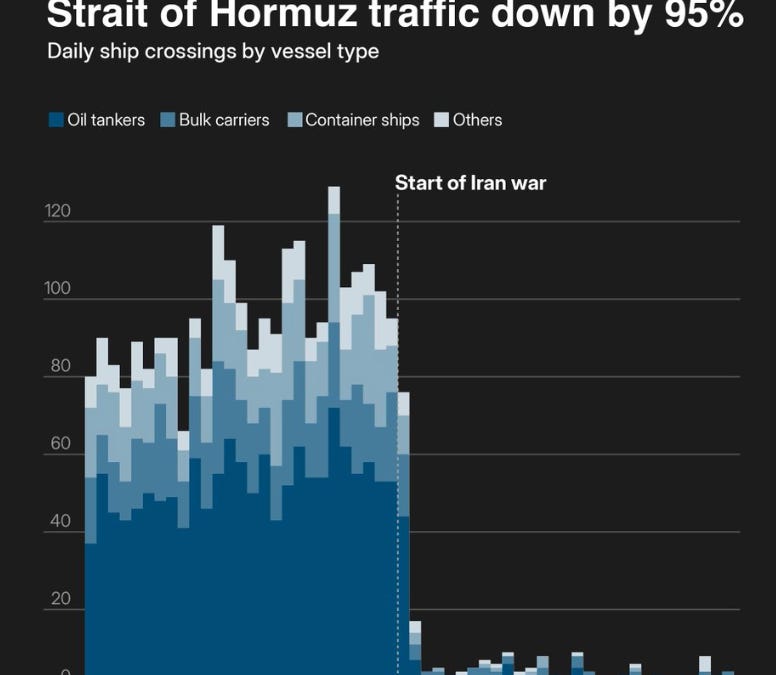
- ● Crossings through the Strait of Hormuz are down 90%.
Optimistic Outlook
This geopolitical shock could compel AI companies and investors to diversify funding sources beyond traditional oil-rich regions, potentially fostering new capital markets or encouraging more strategic, less speculative investments. It might also accelerate the development of alternative energy sources, reducing global reliance on volatile oil supplies.
Pessimistic Outlook
A sustained disruption of Gulf capital could severely constrain the growth of the broader AI ecosystem, particularly for startups reliant on large funding rounds. This scenario risks further concentrating AI development and innovation within a few dominant Big Tech firms, potentially stifling competition and limiting the diversity of AI research and applications.

The Signal, Not
the Noise|
Join AI leaders weekly.
Unsubscribe anytime. No spam, ever.
Generated Related Signals

AI Investment Justification Hinges on Software Cost Reduction
AI's massive investment requires significant software cost cuts to justify.

AWS Defends Dual AI Investments in OpenAI and Anthropic
Amazon's AWS navigates AI model provider conflicts through a long-standing partner-competition strategy.
Software Job Openings Surge, Defying AI Displacement Fears
US software engineering job openings have surged, challenging AI displacement narratives.

Deconstructing LLM Agent Competence: Explicit Structure vs. LLM Revision
Research reveals explicit world models and symbolic reflection contribute more to agent competence than LLM revision.
Qualixar OS: The Universal Operating System for AI Agent Orchestration
Qualixar OS is a universal application-layer operating system designed for orchestrating diverse AI agent systems.

UK Legislation Quietly Shaped by AI, Raising Sovereignty Concerns
AI-generated text has quietly entered British legislation, sparking concerns over national sovereignty and control.