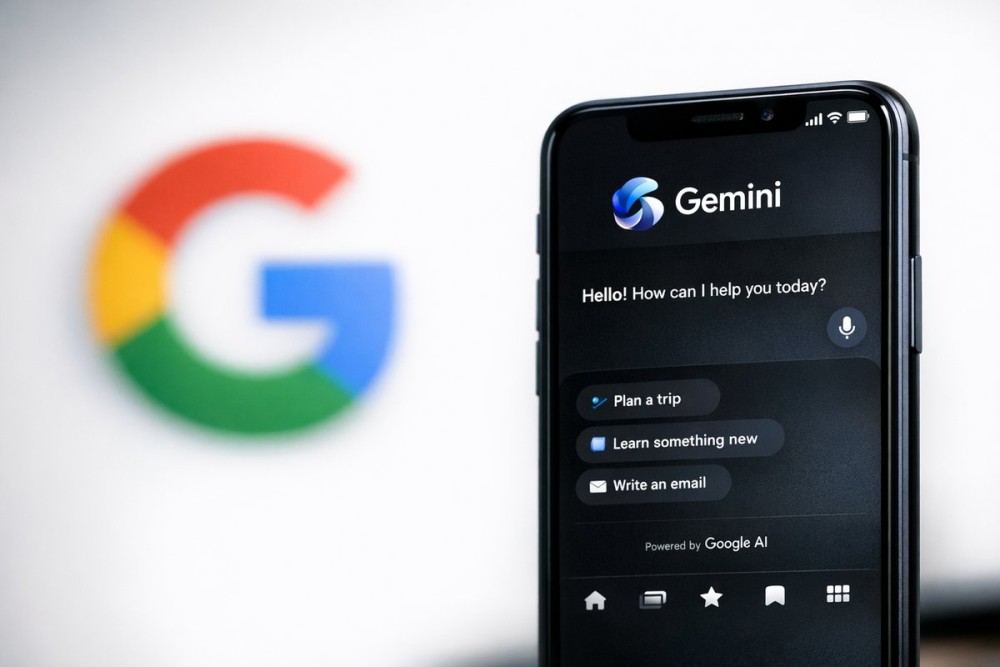
Google Unleashes Personalized Gemini AI Across US Ecosystem
Sonic Intelligence
The Gist
Google expands its personalized Gemini AI to all US users, integrating deeply with its services.
Explain Like I'm Five
"Imagine your smart helper (Gemini) can now read your emails and look at your photos (only if you say it's okay!). This means it can give you super smart answers and help you much better because it knows more about you, like remembering your plans or finding your pictures."
Deep Intelligence Analysis
This expansion directly challenges OpenAI's ChatGPT and Microsoft's Copilot, which are also vying for market share in the personal AI space. Google's approach capitalizes on its unparalleled access to user data, aiming to deliver highly relevant and proactive assistance by understanding individual digital habits and information. The technical integration across multiple flagship products ensures that Gemini is not a standalone application but an integral layer of the user's digital ecosystem, designed to anticipate needs and streamline interactions.
The implications are multifaceted. While promising unprecedented levels of personalization and efficiency, this deep integration inevitably raises significant data privacy concerns. Google's ability to navigate these concerns, ensuring transparency and robust user controls, will be critical for widespread adoption and regulatory compliance. The success of this strategy could redefine user expectations for AI, making deeply personalized, context-aware assistance the new industry standard, while simultaneously intensifying the debate around data ownership and algorithmic influence in daily life.
EU AI Act Art. 50 Compliant: This analysis is based solely on the provided input and does not contain any AI-generated content beyond the interpretation of the source material.
Impact Assessment
This widespread rollout signifies Google's aggressive push into the personal AI market, leveraging its vast ecosystem and user data for a competitive edge. The deep integration of Gemini across core Google products could redefine user interaction with AI, making it a more seamless and context-aware part of daily digital life, while also raising significant privacy questions.
Read Full Story on HeygotradeKey Details
- ● Google launched "Personal Intelligence" to all US users after limited testing.
- ● Feature integrates Gemini with Gmail, Google Photos, and other Google services for personalized responses.
- ● Available across AI Mode in Search, the Gemini app, and Gemini integration in Chrome.
- ● Google's strategy leverages years of accumulated user data for context-based AI superiority.
- ● Directly competes with OpenAI's ChatGPT and Microsoft's Copilot in the personal AI market.
Optimistic Outlook
The deep integration of Gemini with personal data sources like Gmail and Photos promises highly relevant and proactive AI assistance, significantly enhancing user productivity and experience. This move could accelerate the mainstream adoption of AI, making personalized digital assistants indispensable for managing information and tasks across Google's extensive ecosystem, fostering a more intuitive digital interaction.
Pessimistic Outlook
The extensive access of AI to personal data raises substantial privacy concerns, potentially eroding user trust if not managed with utmost transparency and robust safeguards. Google's strategy, while leveraging its data advantage, could face intense regulatory scrutiny and user backlash regarding data security, the potential for misuse, or over-personalization without explicit user control.

The Signal, Not
the Noise|
Join AI leaders weekly.
Unsubscribe anytime. No spam, ever.
Generated Related Signals

Knowledge Density, Not Task Format, Drives MLLM Scaling
Knowledge density, not task diversity, is key to MLLM scaling.

Lossless Prompt Compression Reduces LLM Costs by Up to 80%
Dictionary-encoding enables lossless prompt compression, reducing LLM costs by up to 80% without fine-tuning.
Weight Patching Advances Mechanistic Interpretability in LLMs
Weight Patching localizes LLM capabilities to specific parameters.

Safety Shields Enable AI for Critical Power Grids
New AI framework ensures safety for power grid operations.

AI Boosts Productivity, Demands Urgent Workforce Retraining
AI promises productivity gains but necessitates massive workforce retraining to prevent social inequality.
China Nears US AI Parity, Global Talent Flow to US Slows
China is rapidly closing the AI performance gap with the US, while US talent inflow declines.