
Safety Shields Enable AI for Critical Power Grids
Sonic Intelligence
The Gist
New AI framework ensures safety for power grid operations.
Explain Like I'm Five
"Imagine a smart computer brain that helps run a big power plant, but it also has a super-fast safety checker. This checker makes sure the computer never does anything dangerous, even if it's still learning, keeping our lights on safely."
Deep Intelligence Analysis
The proposed framework employs a high-level RL policy to suggest abstract control actions, which are then rigorously vetted by a deterministic runtime safety shield. This shield, utilizing fast forward simulation, acts as an invariant, filtering out any unsafe actions regardless of the policy's quality or training distribution. This architectural design ensures that hard physical constraints are always respected, a non-negotiable requirement for power grid operations. Evaluated on the Grid2Op benchmark and the ICAPS 2021 large-scale transmission grid, the hierarchical approach demonstrated superior performance, achieving longer episode survival, lower peak line loading, and robust zero-shot generalization to unseen grid topologies, significantly outperforming both flat RL and safety-only methods.
These results underscore that achieving safety and generalization in complex, safety-critical domains like power grids is best accomplished through thoughtful architectural design rather than relying solely on increasingly complex reward engineering. The ability to deploy learning-based controllers that are both adaptive and provably safe opens up transformative possibilities for grid modernization, enhancing resilience against disturbances, optimizing energy flow, and integrating renewable sources more effectively. This paradigm shift will likely influence AI deployment strategies across other critical infrastructure sectors, setting a new standard for safety-aware autonomous systems.
Visual Intelligence
flowchart LR
    A["High Level RL Policy"] --> B["Abstract Control Actions"];
    B --> C["Runtime Safety Shield"];
    C --> D["Fast Forward Simulation"];
    D --> C;
    C --> E["Safe Actions"];
    E --> F["Power Grid Operation"];
Auto-generated diagram · AI-interpreted flow
Impact Assessment
Deploying AI in safety-critical infrastructure like power grids demands absolute reliability. This framework provides a practical solution by explicitly enforcing safety, overcoming key hurdles that have limited the real-world application of reinforcement learning in such vital systems.
Read Full Story on ArXiv cs.AIKey Details
- ● A safety-constrained hierarchical control framework is proposed for power-grid operation.
- ● The framework decouples a high-level reinforcement learning policy from a deterministic runtime safety shield.
- ● The safety shield filters unsafe actions using fast forward simulation.
- ● Evaluated on the Grid2Op benchmark and ICAPS 2021 large-scale transmission grid.
- ● Achieved longer episode survival, lower peak line loading, and robust zero-shot generalization.
Optimistic Outlook
This breakthrough offers a clear path to integrating advanced AI into power grid management, promising enhanced efficiency, resilience, and stability. It could lead to more adaptive and robust energy systems capable of handling complex disturbances and optimizing resource allocation.
Pessimistic Outlook
While promising, the complexity of real-world power grids means unforeseen scenarios could still challenge even robust safety shields. Over-reliance on simulation-based safety mechanisms might not fully capture all emergent behaviors in highly dynamic and interconnected systems.
The Signal, Not
the Noise|
Join AI leaders weekly.
Unsubscribe anytime. No spam, ever.
Generated Related Signals
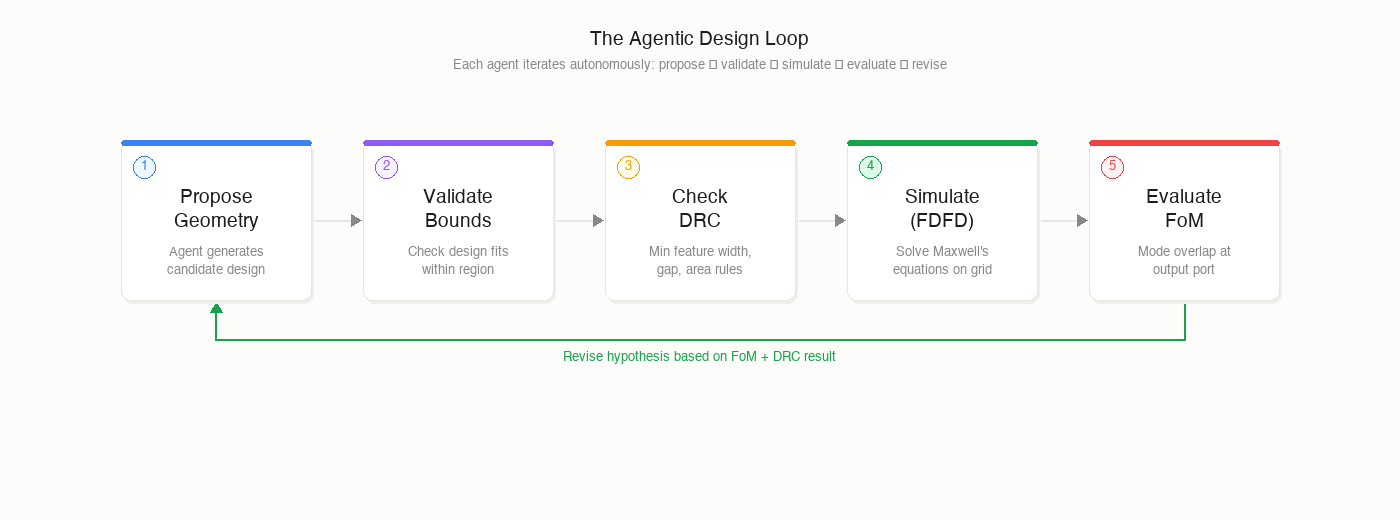
AI Agents Autonomously Design Photonic Chips, Revolutionizing Optical Computing
AI agents successfully designed photonic components autonomously, meeting performance and fabrication criteria.

AlphaCNOT: Quantum Gate Optimization with Model-Based Reinforcement Learning
AlphaCNOT reduces quantum CNOT gate counts by up to 32% using model-based RL.

AI Revolutionizes Academic Peer Review at Scale
AI reviews outperform humans in large-scale academic pilot.
Knowledge Density, Not Task Format, Drives MLLM Scaling
Knowledge density, not task diversity, is key to MLLM scaling.

Lossless Prompt Compression Reduces LLM Costs by Up to 80%
Dictionary-encoding enables lossless prompt compression, reducing LLM costs by up to 80% without fine-tuning.
Weight Patching Advances Mechanistic Interpretability in LLMs
Weight Patching localizes LLM capabilities to specific parameters.