AI Agents Autonomously Design Photonic Chips, Revolutionizing Optical Computing
Sonic Intelligence
The Gist
AI agents successfully designed photonic components autonomously, meeting performance and fabrication criteria.
Explain Like I'm Five
"Imagine tiny roads for light inside a computer chip. Usually, smart engineers draw these roads. But now, we taught a smart robot (AI agent) how to draw these light roads all by itself, and it did a great job! This means computers could get much faster and use less power."
Deep Intelligence Analysis
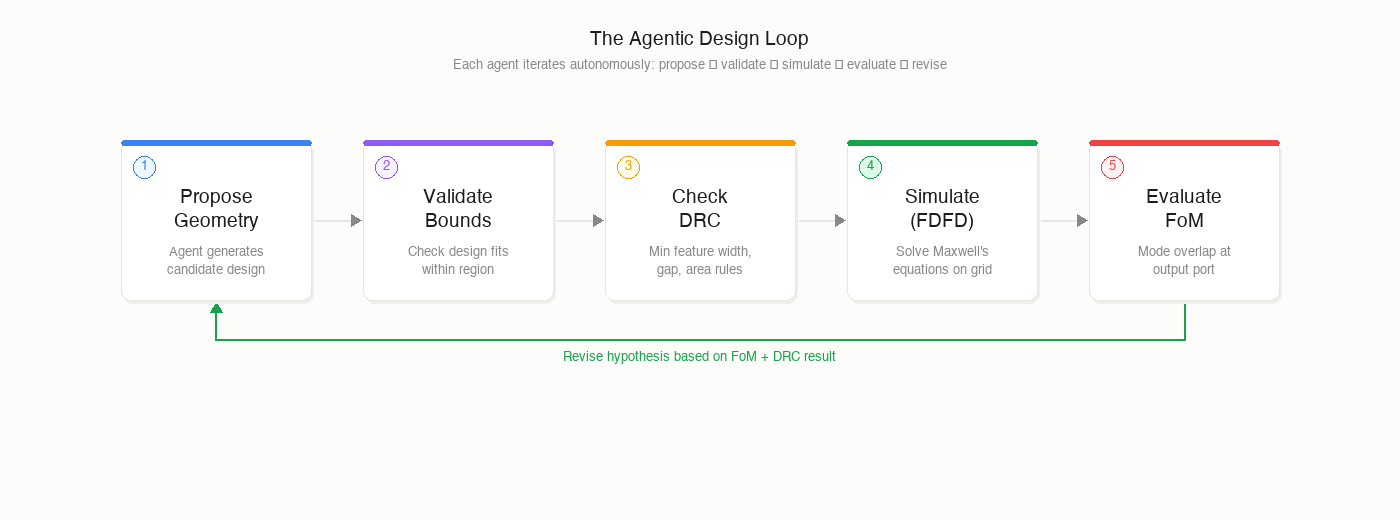
The experimental setup provided agents with access to a local electromagnetic simulator and a fabrication constraint checker, enabling them to reliably create functional photonic devices. Key details include the successful design of common components that met performance criteria, with a specific minimum feature size constraint of 300 nm. This constraint, while more relaxed than some commercial foundry process design kits (PDKs) which enforce 150–200 nm, still imposed meaningful real-world limitations. The ability of AI to navigate these constraints and produce intuitive designs highlights a maturing of agentic AI beyond theoretical applications into tangible engineering solutions.
Looking forward, this development suggests a future where AI agents could not only design but also self-optimize and adapt hardware architectures, potentially leading to highly specialized and efficient chips tailored for specific AI workloads. The challenge will be scaling these capabilities to more intricate, multi-layered designs and integrating them with stricter, commercial-grade fabrication rules. Furthermore, the emergence of autonomous design agents raises new questions regarding intellectual property ownership and the role of human engineers, who may transition from direct design to overseeing and validating AI-generated solutions. This paradigm shift could democratize advanced hardware design, making it accessible to a broader range of innovators.
Visual Intelligence
flowchart LR
    A[Problem Statement] --> B[AI Agent Input];
    B --> C[Submit Geometry];
    C --> D[Electromagnetic Solver];
    D --> E[DRC Check];
    E --> F[Performance Criteria];
    F -- YES --> G[Valid Design];
    F -- NO --> B;
Auto-generated diagram · AI-interpreted flow
Impact Assessment
This demonstrates a significant leap in AI's capability to automate complex engineering design, potentially accelerating the development of advanced optical computing hardware. It shifts the paradigm from human-led optimization to autonomous AI iteration, reducing design cycles and costs.
Read Full Story on EngineeringKey Details
- ● AI agents successfully designed common photonic components.
- ● Designs met performance criteria and were simple/intuitive.
- ● The process involved an electromagnetic simulator and a fabrication constraint checker.
- ● Minimum feature size constraint used was 300 nm.
- ● Photonic technologies are crucial for AI computing platforms due to high information capacity and low power loss.
Optimistic Outlook
Autonomous AI design for photonic chips could dramatically speed up innovation in optical computing, leading to more powerful and energy-efficient AI hardware. This could unlock new frontiers in data processing and machine learning, making complex AI models more accessible and scalable.
Pessimistic Outlook
Over-reliance on autonomous AI design without robust human oversight could introduce unforeseen vulnerabilities or design flaws that are difficult to detect. The simplified fabrication constraints used in this experiment might not translate directly to real-world foundry complexities, potentially leading to a gap between simulated success and practical manufacturability.
The Signal, Not
the Noise|
Join AI leaders weekly.
Unsubscribe anytime. No spam, ever.
Generated Related Signals
Safety Shields Enable AI for Critical Power Grids
New AI framework ensures safety for power grid operations.

AlphaCNOT: Quantum Gate Optimization with Model-Based Reinforcement Learning
AlphaCNOT reduces quantum CNOT gate counts by up to 32% using model-based RL.

AI Revolutionizes Academic Peer Review at Scale
AI reviews outperform humans in large-scale academic pilot.

Knowledge Density, Not Task Format, Drives MLLM Scaling
Knowledge density, not task diversity, is key to MLLM scaling.

Lossless Prompt Compression Reduces LLM Costs by Up to 80%
Dictionary-encoding enables lossless prompt compression, reducing LLM costs by up to 80% without fine-tuning.

Weight Patching Advances Mechanistic Interpretability in LLMs
Weight Patching localizes LLM capabilities to specific parameters.