Economic Frameworks Illuminate AI's Impact on Software Development Labor
Sonic Intelligence
Managerial economics offers a framework to analyze AI's role as capital or labor in software development.
Explain Like I'm Five
"Imagine you're digging holes. You can use many people with spoons (labor) or fewer people with shovels (capital). Economics helps us figure out the best mix of people and tools to dig the most holes, and now we're using it to understand if AI is like a super shovel or just another person helping software builders."
Deep Intelligence Analysis
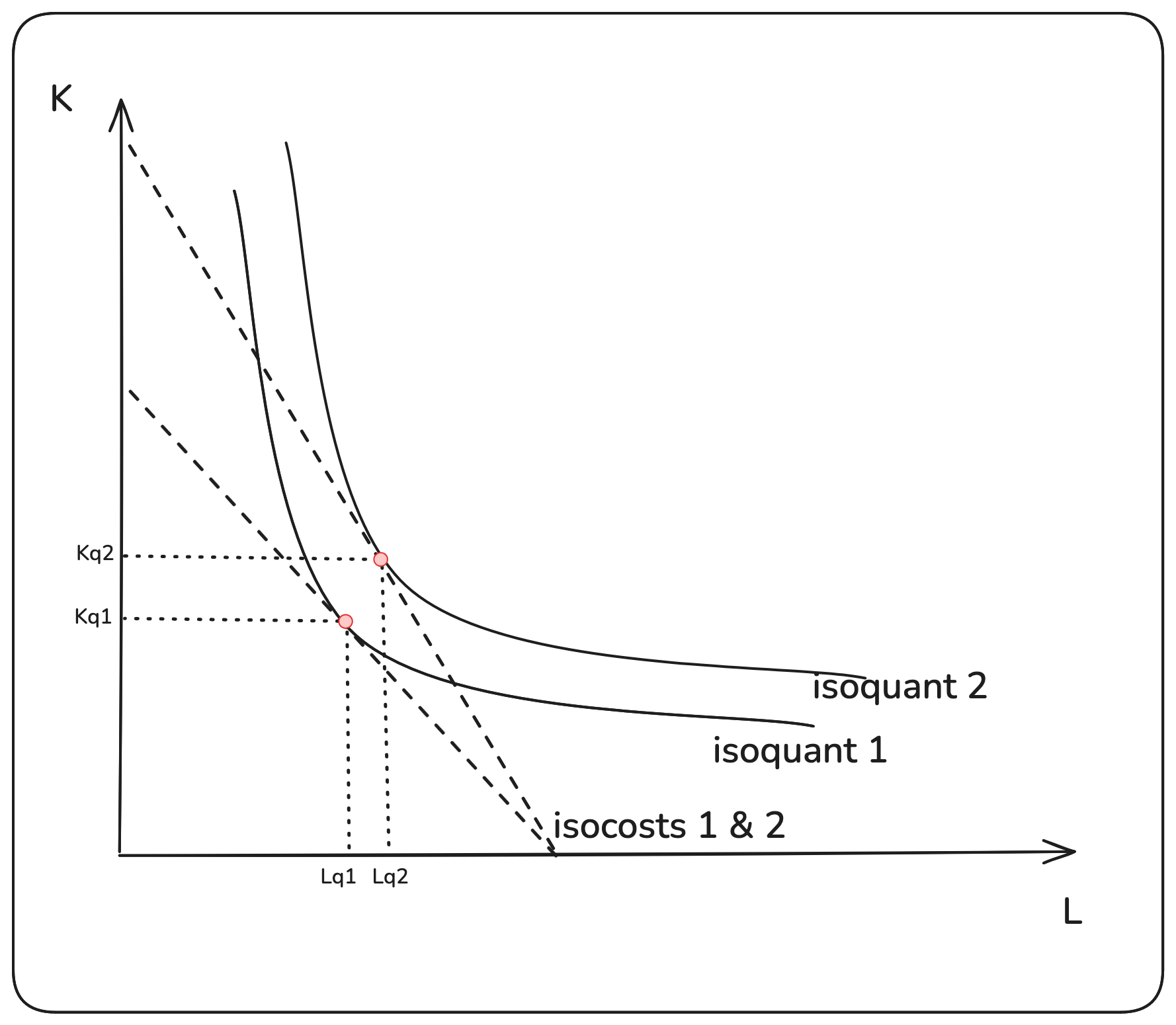
Isoquant curves graphically represent combinations of two inputs—traditionally capital and labor, which can be mapped to AI and software developers, respectively—that yield a constant level of output, such as features delivered or bug-free code. The MRTS, the slope of these curves, quantifies the rate at which one input can be traded for another while maintaining output. The typical convexity of isoquants signifies diminishing MRTS, implying that extreme substitution of one input for another eventually yields diminishing returns. This principle suggests that a complete replacement of human labor by AI, or vice versa, is often suboptimal for maintaining consistent output levels.
Applying this framework allows firms to strategically assess the optimal mix of AI tools and human talent. If AI acts as a perfect substitute, firms might drastically reduce developer headcount as AI costs fall. However, if AI primarily serves as a complement, enhancing developer productivity, the focus shifts to integrating AI to augment human capabilities, leading to higher overall output and potentially new, more complex roles for developers. Understanding this dynamic is crucial for businesses to make informed decisions about technology adoption, talent development, and maintaining competitive advantage in the rapidly evolving software landscape.
Visual Intelligence
flowchart LR
    A["Firm Analysis"] --> B["Identify Inputs"]
    B --> C["Capital (AI)"]
    B --> D["Labor (Devs)"]
    C & D --> E["Evaluate Trade-off (MRTS)"]
    E --> F["Determine Optimal Mix"]
    F --> G["Achieve Output Goal"]
Auto-generated diagram · AI-interpreted flow
Impact Assessment
Applying established economic models provides a robust, non-speculative lens to understand the evolving relationship between AI tools and human labor in software development. This analytical clarity is crucial for strategic workforce planning and investment decisions in the AI era.
Key Details
- Managerial Economics offers a framework to analyze how firms trade off capital and labor to produce goods.
- Isoquant curves illustrate combinations of two inputs (e.g., capital, labor) yielding constant output.
- The Marginal Rate of Technical Substitution (MRTS) quantifies the trade-off rate between inputs along an isoquant.
- Isoquants typically exhibit diminishing MRTS, implying that extreme substitution of one input for another becomes less efficient.
- This economic model can be applied to understand if AI acts as a substitute or complement to software developers.
Optimistic Outlook
This economic perspective can guide businesses to optimally integrate AI as a complementary tool, enhancing developer productivity and fostering innovation rather than solely focusing on job displacement. It could lead to new hybrid roles and increased overall output in the software industry.
Pessimistic Outlook
If AI is primarily viewed as a perfect substitute for human developers, it could lead to significant job displacement and a race to the bottom in labor costs, potentially devaluing human expertise. Misapplication of the framework could result in inefficient capital allocation and suboptimal production.
Get the next signal in your inbox.
One concise weekly briefing with direct source links, fast analysis, and no inbox clutter.
More reporting around this signal.
Related coverage selected to keep the thread going without dropping you into another card wall.