Meta's KernelEvolve Agent Autonomously Optimizes AI Hardware Kernels
Sonic Intelligence
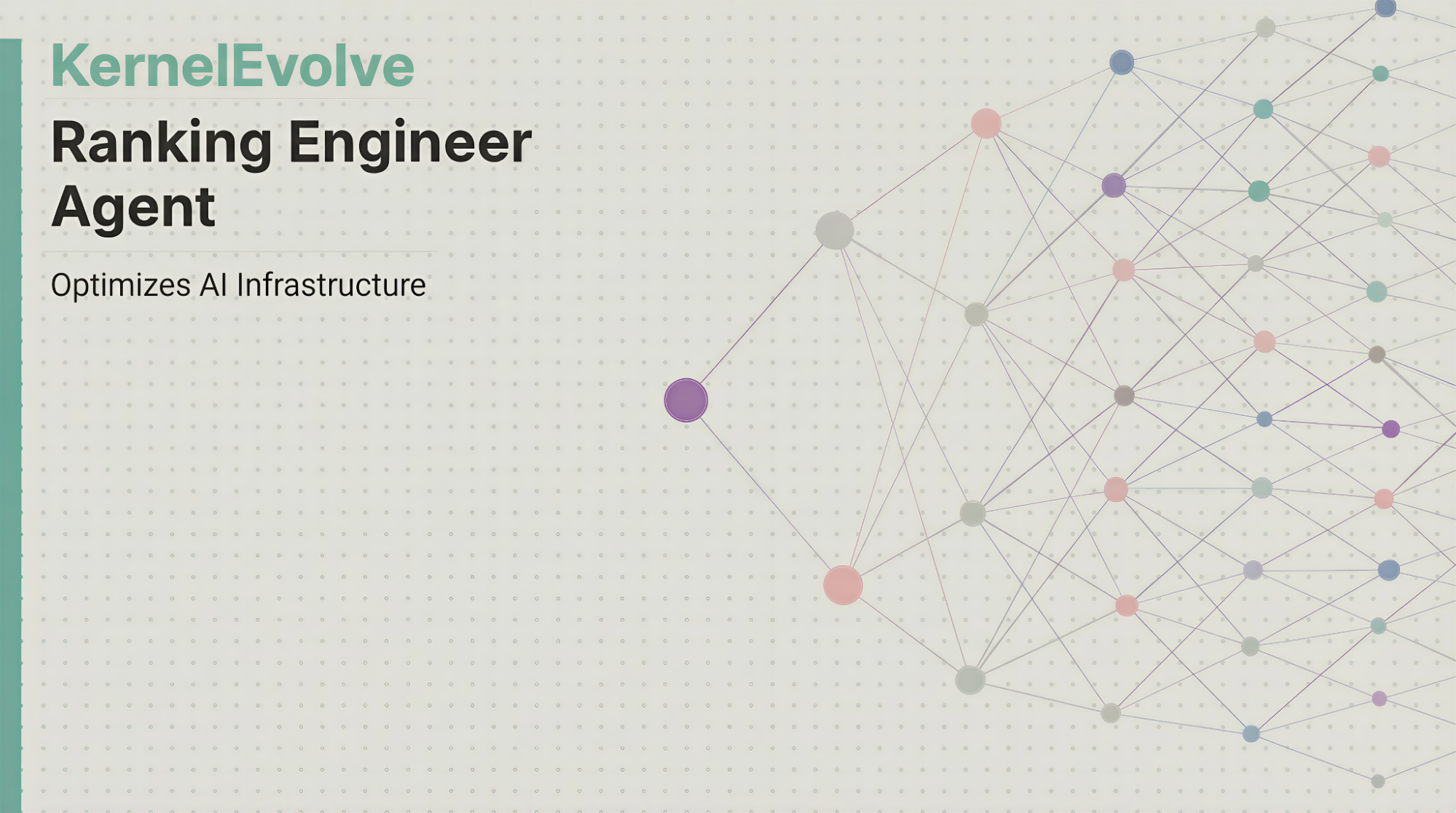
Meta's KernelEvolve agent autonomously optimizes low-level AI hardware kernels.
Explain Like I'm Five
"Meta has a smart computer program that teaches other computer programs how to run super fast on all sorts of different computer chips, even ones Meta made itself. It's like having a super-fast coach for computer code."
Deep Intelligence Analysis
KernelEvolve directly tackles the challenge of optimizing performance across this diverse hardware landscape. It has demonstrated significant gains, including over 60% inference throughput improvement for the Andromeda Ads model on NVIDIA GPUs and over 25% training throughput improvement for an ads model on Meta's MTIA silicon. By treating kernel optimization as a search problem, the agent evaluates hundreds of candidate kernels, surpassing human expert performance and compressing weeks of specialized engineering effort into hours. Its capability to generate kernels in various DSLs and low-level languages ensures broad applicability across Meta's extensive AI workloads.
The implications extend beyond Meta's immediate operational needs. This agentic approach to infrastructure optimization could become a standard for large-scale AI deployments, enabling faster development cycles and more efficient resource utilization across the industry. However, the increasing autonomy of such systems necessitates robust validation frameworks and transparent mechanisms to ensure reliability and prevent the introduction of subtle, hard-to-diagnose performance regressions or security vulnerabilities within critical hardware-software interfaces.
_Context: This intelligence report was compiled by the DailyAIWire Strategy Engine. Verified for Art. 50 Compliance._
Visual Intelligence
flowchart LR
    A["High-Level Model"] --> B["Identify Kernel Needs"];
    B --> C["Generate Candidate Kernels"];
    C --> D["Evaluate Performance"];
    D -- "Feedback" --> C;
    D -- "Optimal?" --> E{"Achieve Target"};
    E -- "No" --> C;
    E -- "Yes" --> F["Deploy Optimized Kernel"];
Auto-generated diagram · AI-interpreted flow
Impact Assessment
KernelEvolve addresses the critical scaling challenge of optimizing AI models across diverse hardware, significantly improving performance and accelerating development cycles. This autonomous approach is essential for Meta's vast AI infrastructure and sets a precedent for agentic optimization in complex systems.
Key Details
- KernelEvolve is an agentic kernel authoring system developed by Meta.
- It optimizes kernels across heterogeneous hardware: NVIDIA GPUs, AMD GPUs, Meta's MTIA chips, and CPUs.
- Achieved over 60% inference throughput improvement for Andromeda Ads model on NVIDIA GPUs.
- Achieved over 25% training throughput improvement for an ads model on Meta's MTIA chips.
- Generates kernels in DSLs (Triton, Cute DSL, FlyDSL) and low-level languages (CUDA, HIP, MTIA C++).
Optimistic Outlook
This technology promises substantial efficiency gains for large-scale AI deployments, reducing operational costs and enabling more complex models to run faster. Its broad applicability across hardware types could democratize high-performance AI by automating a highly specialized and time-consuming task.
Pessimistic Outlook
Over-reliance on autonomous agents for critical infrastructure optimization could introduce new vulnerabilities or obscure complex performance bottlenecks, making human oversight and debugging more challenging. The proprietary nature of some hardware and DSLs might limit broader industry adoption or transparency.
Get the next signal in your inbox.
One concise weekly briefing with direct source links, fast analysis, and no inbox clutter.
More reporting around this signal.
Related coverage selected to keep the thread going without dropping you into another card wall.